
Commercial ceiling-suspended split units
Ceiling-Suspended Split AC Cleaning
Exposed ceiling-suspended split units need a different cleaning plan from ceiling cassettes or concealed ducted systems. Evolt Cool Engineering first checks the unit type, mounting height, access, available work period and drainage context, then confirms the practical scope and quotation.
- Identify the exposed unit form
- Check height and working space below
- Define shutdown, protection and handover needs
Prepare quotation details
Unit quantity is only the starting point;
height and site constraints also matter
The same model in a classroom, office, shop or reception area can require a different access plan and available work period. These details reduce quotation assumptions and the risk of discovering access limits only after attendance.
- 01
Units and locations
Quantity, room or zone, model or clear photos, and whether the units belong to a single-split or VRV/VRF system.
- 02
Height and working space
Height from floor to the unit underside, service space at each end, and any desks, shelving, counters, lights or circulation areas below.
- 03
Room use and available work period
How the room is used, when it is occupied, when the relevant unit can stop, and any building or premises access rules.
- 04
Known observations
Dripping, unusual drainage, reduced airflow, noise, alarms, recent repairs or other conditions that should be recorded with the enquiry.
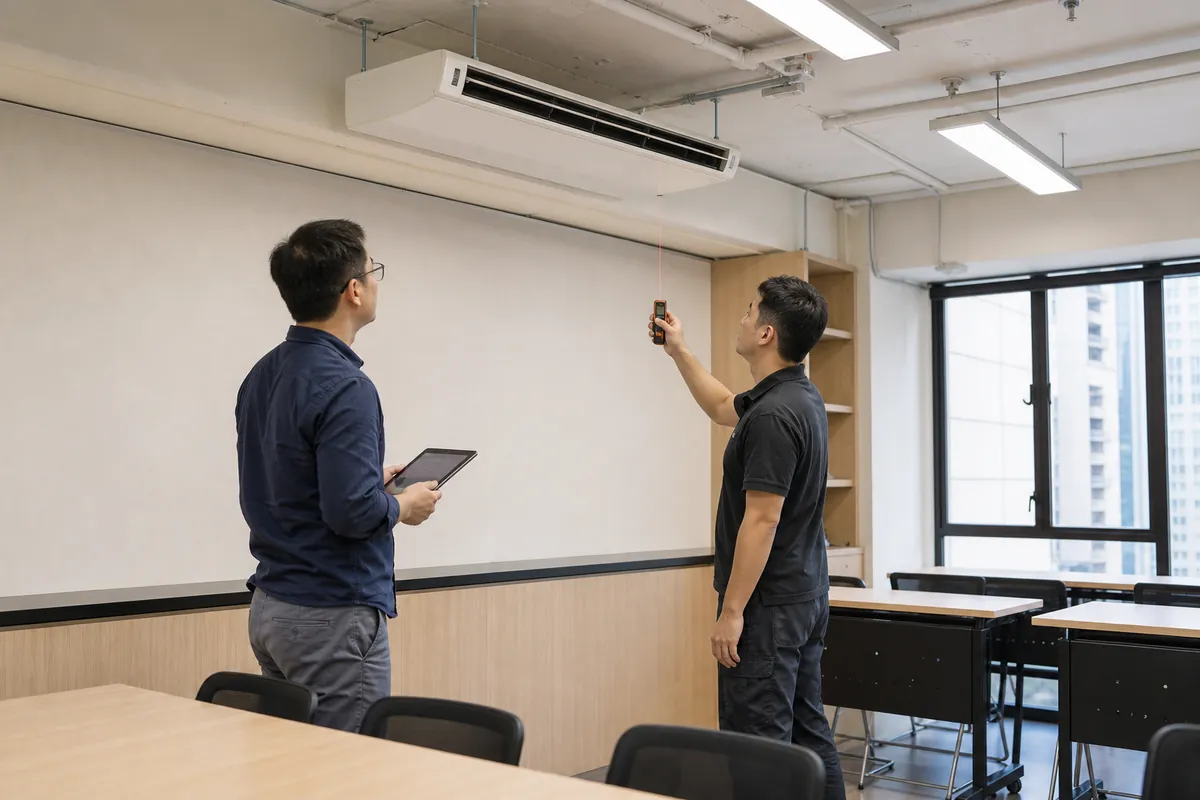
Photograph the unit in its surroundings
A close-up of the outlet alone does not always show enough. Include the whole unit, ceiling, lights, furniture below and space available for a working platform.
From quotation to reinstatement
Five main steps for ceiling-suspended AC cleaning
A ceiling-suspended unit sits above an occupied commercial space. The quotation therefore needs to address high-level access, the work area below, shutdown and isolation, wash-water handling and reinstatement as well as the cleaning items. The exact method depends on the model, site and agreed scope.
- 01
Confirm the unit type, position and scope
Check the model, quantity, mounting height, space below, quoted components and available work period.
- 02
Set up access, isolation and protection
Confirm shutdown and isolation, suitable work-at-height equipment, access and work-zone separation, furniture protection and wash-water handling.
- 03
Clean to suit the unit design
Treat the casing, filter, safely accessible coil, fan, drain pan and drainage components stated in the quotation.
- 04
Refit and check the equipment
After drying, refit the components, restart the unit and check basic operation, unusual noise and visible drainage.
- 05
Check completion and follow-up
Confirm the treated components, reinstatement, basic observations and separately arranged work against the quotation.
Cleaning and repair boundary
Confirm the accessible components unit by unit
The model, accessories, dismantling method, condition and access determine whether the casing, filter, coil face, fan section, drain pan and drainage arrangement can be handled during the same visit. The quotation lists the relevant components and work.
Items that can be listed in the cleaning quotation
- Unit casing, return-air and supply-air areas
- Removable filters and accessible coil surfaces
- Fan or blower areas that the model allows safe access to
- Confirmed drain-pan and drainage-path items, plus basic drainage observations
- Drying, reinstatement, basic operating checks and work records
Items assessed and quoted separately
- Fault diagnosis, parts replacement and repeated-leak investigation
- Control boards, sensors, distribution, fixed electrical or live work
- Refrigerant work, pressure testing, charging or leak repair
- Drain alterations, ceiling openings, support changes, painting or builder’s work
- Duct cleaning, formal IAQ measurement, pathogen or health verification

Handover should match the work actually completed
Photos can record the unit, work position and visible condition. They do not turn a cleaning record into proof of performance, hygiene or IAQ.
Reinstatement and handover
You should know what was completed
and what still needs attention
- 01Unit and location
List the completed units, rooms or equipment location so multi-unit premises can track the work accurately.
- 02Completed items and exceptions
Record the components addressed and anything inaccessible, handled separately or requiring a separate cleaning arrangement.
- 03Reinstatement and observations
Note casing, filters, outlet louvres, basic operation, drainage observations and any exceptions.
- 04Follow-up arrangement
If parts, electrical, refrigerant, drainage or other faults appear, state the separate assessment and approval process clearly.
Related services
Cleaning, repair and planned maintenance
address different needs
Cleaning can address the agreed cleaning and drainage items. For shutdowns, alarms, electrical issues, refrigerant faults or parts failures, learn about the appropriate diagnosis and repair services.
Find the cause before choosing the work
For shutdowns, poor cooling, alarms, repeated leaks, noise or problems that remain after cleaning.
Learn about commercial AC repair Multiple units and ongoing managementPlace cleaning within a maintenance plan
Set up planned work around equipment types, quantities, operating windows, records and approval for additional items.
See Evolt Care maintenance plans Urgent or timing-led workConfirm after-hours arrangements separately
If the site only allows nights, weekends or holidays, or a failure is already affecting operations, state the required work period and impact.
See emergency and after-hours workCommon questions
Ceiling-suspended split AC cleaning enquiries
Do accordion, harmonica and ceiling-suspended describe the same unit?
In Hong Kong, accordion or harmonica-style can refer to the long exposed split indoor unit installed below the ceiling. Internal construction still varies by brand and model, so unit and equipment-label photos are useful for quotation.
How often should these units be cleaned?
There is no single interval for every premises. The exact model, operating hours, exposure to dust, grease, steam or other conditions, filter and drainage condition, maintenance records and inspection findings all matter.
How are dripping or poor-cooling issues followed up?
Dirt loading or drainage blockage is one factor to check. Where the findings point to parts, installation, controls, electrical or refrigerant issues, we will explain the appropriate diagnosis or repair arrangement.
Can the work take place during business hours?
Business-hours work is confirmed from the unit position, working platform, controlled area below, furniture or stock protection, circulation, occupancy, noise, wet-work controls and shutdown impact. Share the room’s operating hours before arrangements are confirmed.
How is IAQ certification handled?
Formal IAQ assessment and certification follow their own measurement, assessment and professional requirements. A routine AC cleaning record documents the completed cleaning scope; any IAQ, pathogen, health or energy claim requires the corresponding evidence.
Unit photographs, mounting height and an available work period
are enough to begin scoping
Provide Evolt Cool Engineering with the unit quantity, locations, room use, constraints below the units and known observations. We will first confirm that they are ceiling-suspended units, then identify the details needed for a quotation. If another issue is found during cleaning, we will explain what can be followed up during the visit and what should be arranged separately for inspection or repair.